
 5.0 on Google, 19 reviews
Related care: Sports Injuries and Meniscus Tear Surgery. Dr. Hamie sees patients at Clemenceau Medical Center, Dubai Healthcare City.
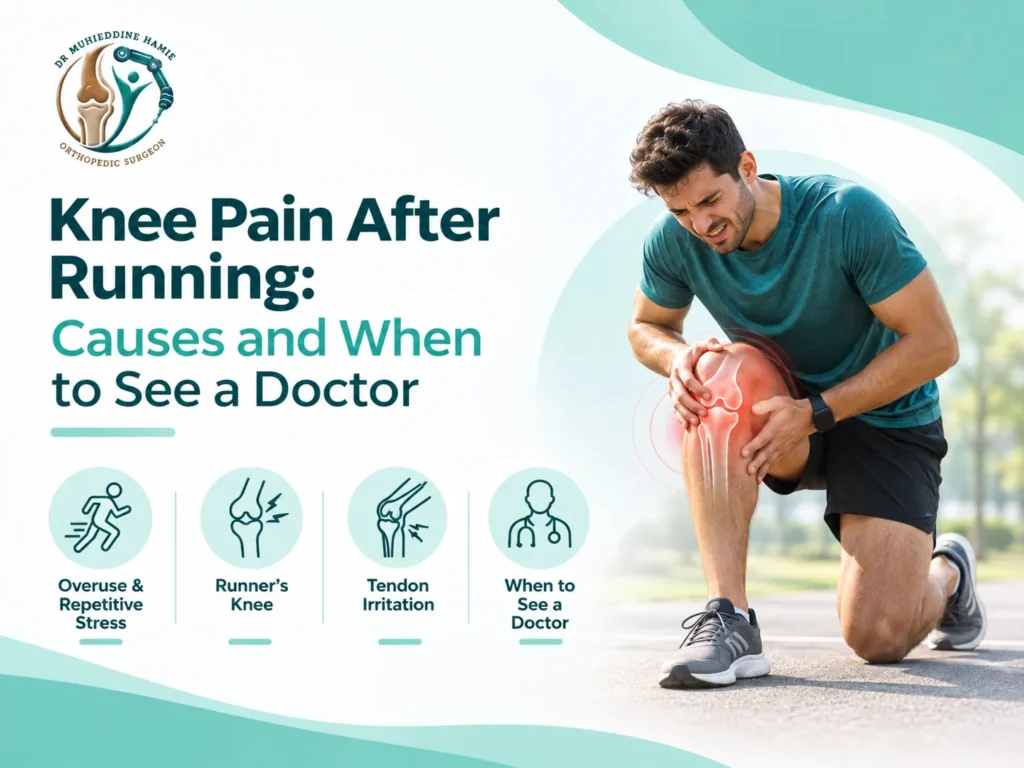
Knee pain after running indicates mechanical overload, soft-tissue inflammation, or structural joint irritation that requires systematic clinical evaluation. Addressing discomfort early protects your joint cartilage and preserves your training schedule across Dubai.
Running places repetitive impact forces through the lower extremities, multiplying ground reaction loads across the patella and tibiofemoral joint. While mild muscle fatigue often settles within hours, persistent knee pain after running signals that underlying structures are struggling to absorb force. Identifying whether your symptoms stem from training errors, muscular deficits, or intra-articular injuries prevents acute irritation from turning into chronic functional impairment.
Early orthopedic intervention restores balanced biomechanics and keeps recreational joggers and competitive athletes moving safely. Taking a methodical approach to joint discomfort allows you to address the root mechanical cause rather than just masking symptoms. At Dr. Hamie Clinic in Dubai Healthcare City Phase 2, specialist evaluations identify the precise anatomical origin of knee pain after running to support safe, sustainable athletic conditioning.
Defining the Mechanical Drivers of Knee Pain After Running
Knee pain after running refers to acute or cumulative discomfort around the tibiofemoral or patellofemoral joints following athletic loading. It typically stems from repetitive ground impacts, training spikes, hip abductor weakness, or structural cartilage irritation that alters lower-extremity load distribution during the gait cycle.
Understanding how running knee pain develops requires examining the kinetic chain from the foot strike up to the pelvis. Each running stride transmits loads equal to three to five times your body weight directly through the knee joint. If the foot overpronates, the tibia rotates internally, or the gluteal muscles fatigue, the knee joint absorbs abnormal shearing forces.
Consequently, knee pain after running rarely occurs in complete isolation from the rest of the body. Instead, it reflects how well your tendons, cartilage, and stabilizing muscles handle cumulative mileage. Disregarding persistent knee pain after running forces surrounding muscles to compensate, which frequently creates secondary imbalances in the hip or Achilles tendon.
Clinical evaluations focus on identifying where forces concentrate unnaturally across the joint. Pinpointing the mechanical drivers of knee pain after running allows runners to adjust training parameters and rebuild tissue capacity without unnecessary downtime.
Anatomical Mapping of Common Knee Pain After Running
Pinpointing the exact physical location of discomfort provides immediate clues regarding which structural tissue has sustained irritation. Runners across Dubai frequently present with symptoms concentrated in distinct anatomical zones:
| Anatomical Location | Primary Clinical Condition | Typical Symptom Presentation | Common Mechanical Triggers |
| Anterior (Front of Kneecap) | Patellofemoral Pain Syndrome | Diffuse dull ache around or behind the kneecap | Weak quadriceps, prolonged sitting, stair descent |
| Lateral (Outer Side of Knee) | IT Band Syndrome Knee | Sharp, burning friction pain over the lateral condyle | Tight hip tensors, repetitive downhill running, excessive cross-over gait |
| Inferior (Below Kneecap) | Patellar Tendinopathy (Jumper's Knee) | Localized tenderness along the patellar tendon | Explosive sprint acceleration, hard running surfaces |
| Joint Line (Inner or Outer Margin) | Meniscus Irritation or Tear | Sharp joint line ache with clicking or mild swelling | Sudden twisting movements, deep impact loading |
| Posterior (Back of Knee) | Popliteus Tendinitis or Baker's Cyst | Tight fullness and aching behind the knee capsule | Hyperextension stress, downhill road running |
Recognizing these specific patterns helps runners understand their symptoms before seeing an orthopedic specialist. A focused clinical examination confirms the anatomical diagnosis and rules out deeper structural tears.
Primary Overuse Conditions Causing Knee Pain When Running
Overuse conditions represent the vast majority of cases where individuals experience acute or progressive knee pain when running. These injuries develop when training loads exceed the biological rate of tissue adaptation.
Patellofemoral Pain Syndrome and Anterior Overload
Often described colloquially as runner's knee, patellofemoral pain syndrome represents the single most common cause of knee pain after running. The underside of the kneecap glides through the femoral trochlear groove during every knee flexion and extension cycle. If muscle imbalances cause the patella to track laterally, friction increases across the retro-patellar cartilage.
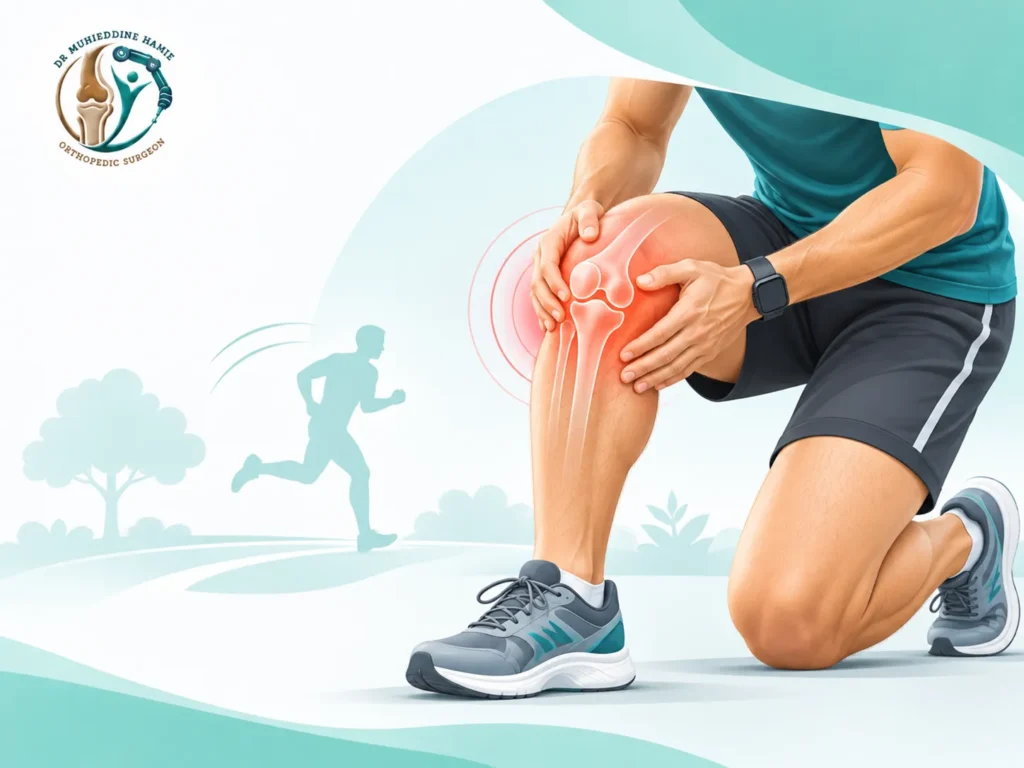
Runners experiencing this condition report an escalating ache during or immediately following outdoor track or road workouts. The sensation often worsens when climbing stairs, sitting with knees bent, or dealing with knee pain when squatting. Restoring quadriceps balance and strengthening hip external rotators relieves tracking stress, helping to resolve knee pain after running effectively.
Understanding IT Band Syndrome Knee Irritation
Lateral joint line discomfort frequently points to IT band syndrome knee irritation. The iliotibial band is a thick fibrous band of fascia that runs down the outside of the thigh, crossing the knee joint to attach to the shin bone.
As the knee flexes past thirty degrees during a running stride, the band slides over the lateral femoral epicondyle. If the tensor fasciae latae muscle becomes excessively tight or the gluteus medius fails to stabilize the pelvis, repetitive friction develops. Runners with IT band syndrome knee irritation report a sharp, stinging pain on the outer knee that intensifies with every foot strike.
Ignoring symptoms of an IT band syndrome knee issue makes prolonged running nearly impossible. Addressing hip weakness, modifying running stride cadence, and performing targeted soft-tissue therapy are necessary steps to reduce friction and eliminate knee pain after running.
Patellar Tendinopathy and Tendon Overload
High-intensity speed intervals and repeated hill ascents place intense demands on the patellar tendon. When this connective tissue is subjected to repetitive mechanical strain without adequate recovery, microscopic collagen disorganization can develop.
Patients notice localized tenderness right at the inferior pole of the patella. While mild running knee pain may feel manageable during the warm-up phase, the ache intensifies sharply after cooling down. Progressive eccentric strengthening of the extensor mechanism rebuilds tendon load tolerance, resolving persistent knee pain after running.
Send your X-ray or MRI on WhatsApp and Dr. Hamie will review it before your visit.
Biomechanical and Environmental Risk Factors
Training environments and running habits across the UAE influence joint stress directly. Evaluating systemic variables helps identify why knee pain when running begins unexpectedly:
- Sudden training volume spikes: Increasing weekly mileage or workout intensity by more than ten percent per week overwhelms soft-tissue adaptation rates.
- Repetitive hard running surfaces: Continuous training on asphalt or unyielding concrete tracks transmits high peak shock waves through the knee joint.
- Worn or unsupportive running footwear: Running shoes lose structural midsole cushioning after three hundred to five hundred miles, reducing shock absorption.
- Kinematic running gait faults: An over-striding foot plant creates excessive braking forces, sending sharp impact loads straight into the knee.
Modifying these environmental variables lowers baseline joint stress. Correcting training errors protects joint surfaces, making chronic running knee pain far less likely to return.
Conservative Management and Practical Home Recovery Steps
When knee pain after running first appears, starting simple, targeted self-care helps calm acute tissue irritation. Taking conservative measures early prevents mild inflammation from turning into a severe repetitive strain injury.
During the initial forty-eight hours, modifying your training schedule is essential.
Temporarily replacing road running with low-impact cardiovascular cross-training, such as swimming, pool running, or stationary cycling, maintains aerobic conditioning without overloading healing tissues. Applying ice packs for fifteen to twenty minutes after exercise helps soothe localized tendon inflammation.
Furthermore, dynamic mobility work and foam rolling targeting the quadriceps, calves, and gluteal muscles relieve tension across the patellar complex. When running knee pain is addressed through rest and smart exercise modification, tissues often settle within one to two weeks. However, if knee pain after running persists despite rest, scheduling an orthopedic evaluation is recommended.
For athletes who have previously undergone surgical procedures, adhering to structured protocols for returning to sport after knee surgery ensures that joint structures are not loaded prematurely. Gradual loading protects reconstructed tissues while supporting a safe return to distance running.
Clinical Red Flags and When to Consult an Orthopedic Specialist
While mild muscular aches are common in sports, certain warning signs require professional medical assessment. Consulting an orthopedic specialist becomes necessary when knee pain after running is accompanied by structural or neurological symptoms.
Seek prompt medical evaluation if you experience any of the following clinical signs:
- Immediate or severe joint swelling: Fluid accumulation developing within hours of a run suggests intra-articular bleeding or a meniscus tear.
- Inability to bear full body weight: Sharp pain that prevents normal, unassisted walking indicates bone contusions, stress fractures, or ligament sprains.
- Mechanical locking, catching, or giving way: An inability to straighten the knee or sudden buckling points toward displaced meniscal tissue.
- Pain that wakes you from sleep: Unprovoked nocturnal pain indicates progressive inflammatory synovitis or bone stress injuries.
- Symptoms lasting over two weeks: Discomfort that fails to improve despite rest, icing, and activity modification requires diagnostic imaging.
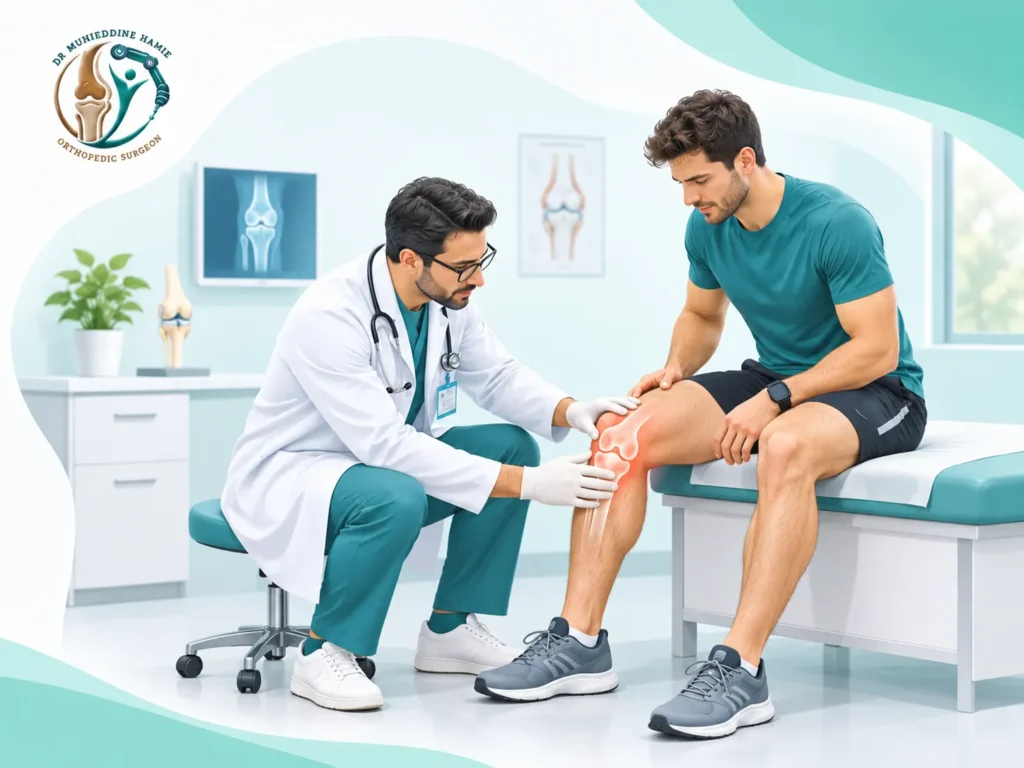
An experienced orthopedic surgeon conducts clinical stress tests, reviews weight-bearing digital X-rays, and utilizes high-resolution MRI scans to evaluate soft tissues accurately. Identifying underlying joint damage early ensures that minor running injuries do not cause long-term cartilage loss.
Advanced Diagnostic and Sports Care at Dr. Hamie Clinic
Managing running injuries requires an understanding of dynamic joint kinetics, athlete conditioning, and modern orthopedic medicine. Dr. Muhieddine Hamie brings international orthopedic fellowship credentials and extensive sports medicine expertise, including a FIFA Diploma in Football Medicine, to his practice in Dubai Healthcare City Phase 2.
At Dr. Hamie Clinic, patient assessments go beyond simple static examinations. Dr. Hamie reviews your running history, footwear wear patterns, and functional movement mechanics to uncover why knee pain after running developed. The clinic prioritizes conservative management first, using focused physical therapy, gait modifications, and targeted biological treatments to restore joint comfort without surgery.
When diagnostic imaging reveals structural ligament tears, cartilage defects, or meniscal pathology, Dr. Hamie utilizes advanced, tissue-sparing arthroscopic techniques. Tailored rehabilitation plans guide runners through criteria-based functional stages, ensuring a safe, confident return to distance running across the UAE.
Protect Your Running Performance and Mobility Today
Living with knee pain after running should not keep you away from the sports, fitness routines, and outdoor active lifestyle you enjoy across Dubai. Gaining clinical clarity regarding your symptoms is the first step toward lasting joint health.
Dr. Muhieddine Hamie provides comprehensive orthopedic evaluations, high-resolution diagnostic reviews, and evidence-based sports injury treatments at Dr. Hamie Clinic. Take a decisive step toward eliminating running knee pain and protecting your joints for years of active running.
Schedule Your Comprehensive Orthopedic Consultation
Connect directly with the clinical team at Dr. Hamie Clinic in Dubai to evaluate your running injury and receive an individualized recovery plan. Book your consultation today through our online appointment system or contact our Al Jaddaf clinic directly.
Conclusion
Experiencing knee pain after running is a common challenge for active individuals, but it should never be accepted as an unavoidable part of training. Whether caused by runner's knee, IT band syndrome knee friction, or early cartilage wear, recognizing warning signs early allows for effective treatment.
A successful return to running relies on balancing training loads, strengthening dynamic stabilizers, and allowing adequate time for biological recovery. Addressing running knee pain systematically protects joint cartilage from premature degeneration.
Partnering with an experienced orthopedic sports specialist ensures that your recovery plan addresses your personal biomechanics and athletic goals. Resolving knee pain after running empowers you to lace up your running shoes and train across Dubai with comfort, strength, and complete confidence.
Frequently Asked Questions
1. What are the most common causes of knee pain after running?
The most frequent causes include patellofemoral pain syndrome (runner's knee), IT band syndrome, patellar tendinopathy, and early meniscus irritation resulting from training errors, weak hip stabilizers, or unsupportive running footwear.
2. How can I tell if my running knee pain is serious?
Running knee pain is serious if accompanied by rapid joint swelling, an inability to bear weight, mechanical locking or giving way, or sharp pain that persists for more than two weeks despite resting and applying ice.
3. How does an IT band syndrome knee injury feel during a run?
An IT band issue typically presents as a sharp, burning pain on the outer side of the knee that begins after a specific running distance and worsens when running downhill or taking long strides.
4. Can I continue running if I have mild knee pain when running?
Running through sharp pain that alters your stride is not recommended, as it can cause compensatory injuries. Mild discomfort should prompt a reduction in running volume and an emphasis on hip and quadriceps strengthening.
5. What is the fastest way to relieve knee pain after running at home?
The fastest conservative approach involves temporary rest from impact, applying ice packs for fifteen to twenty minutes, performing gentle quadriceps and calf stretches, and using low-impact cross-training like swimming or cycling.
6. When should I consult an orthopedic doctor for knee pain after running?
You should see an orthopedic specialist if pain prevents normal daily walking, if the knee swells visibly, if you feel a clicking or catching sensation, or if symptoms do not improve after ten to fourteen days of rest.

Consultant Orthopedic Surgeon at Clemenceau Medical Center, Dubai. He performs robotic-assisted, total, partial and revision knee replacement and treats sports injuries of the knee.
Meet Dr. Hamie