
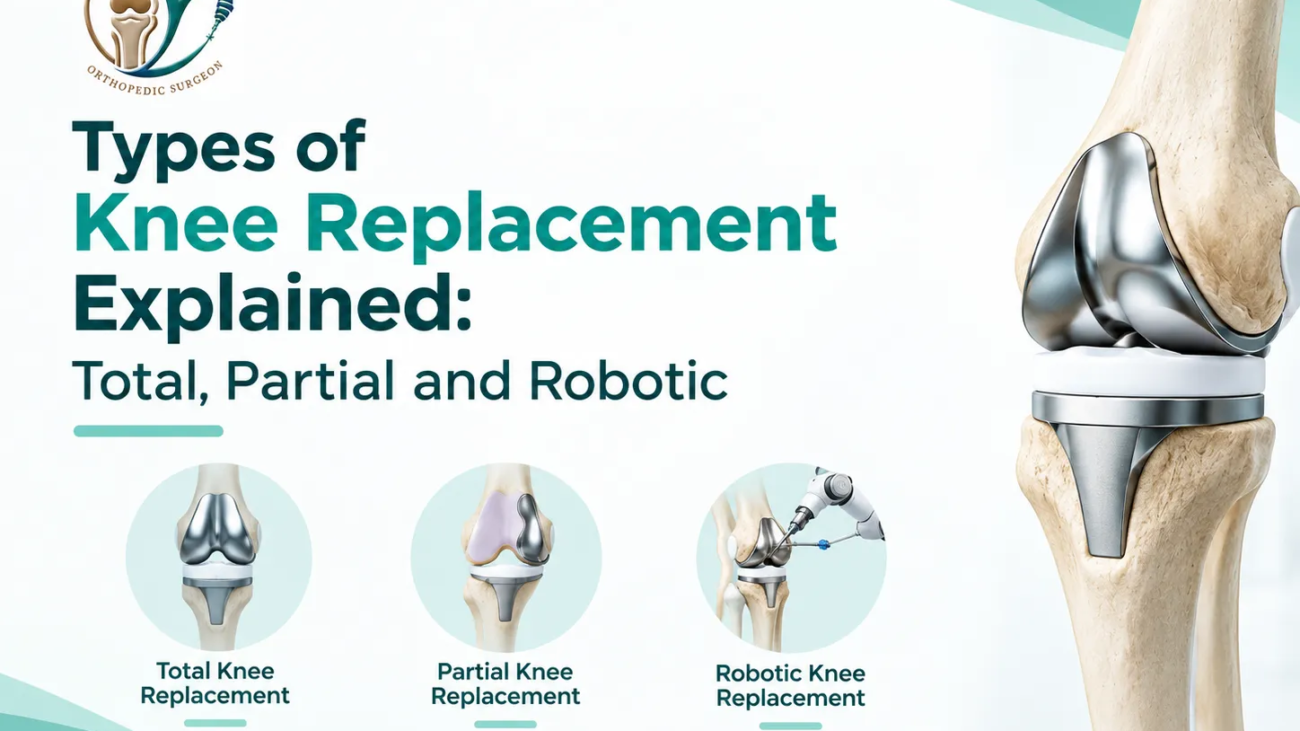
Persistent joint degeneration can transform everyday routines into demanding physical challenges. Exploring the primary types of knee replacement provides individuals with the clinical clarity needed to choose the most effective path toward pain-free movement.
Many active residents in Dubai endure chronic discomfort under the impression that joint reconstruction involves a single, uniform surgical procedure. However, modern orthopaedic advancements offer diverse types of knee replacement designed to treat specific patterns of cartilage loss. Selecting among the available types of knee replacement ensures that your surgical plan matches your unique anatomy, lifestyle expectations, and functional goals.
Understanding clinical distinctions across modern types of knee replacement empowers you to participate actively in your musculoskeletal care. Specialist evaluation clarifies how different surgical approaches preserve native bone and balance soft tissues. At Dr. Muhieddine Hamie Clinic, patient assessments focus on anatomical precision, tissue preservation, and lasting functional recovery.
Anatomy and Mechanics Defining Types of Knee Replacement
The human knee functions as a complex, three-compartment weight-bearing joint. The medial compartment spans the inner aspect, the lateral compartment covers the outer side, and the patellofemoral compartment supports movement under the kneecap. Categorising types of knee replacement depends directly on whether degenerative changes involve one, two, or all three of these functional areas.
When evaluating types of knee replacement, surgeons assess the structural integrity of native cruciate ligaments and surrounding bone. If articular wear is confined to a single compartment, partial resurfacing protects healthy tissue. Conversely, extensive cartilage breakdown across multiple compartments requires total joint reconstruction.
Diagnostic imaging, dynamic stress testing, and clinical examinations guide the selection of types of knee replacement. Choosing an intervention aligned with your specific disease pattern safeguards joint kinetics, minimizes tissue trauma, and supports a natural gait.
Understanding Different Types of Knee Replacement Surgery
Navigating the spectrum of joint resurfacing begins by reviewing the primary clinical categories. Orthopaedic surgeons divide modern options into distinct operative approaches based on the extent of tissue resurfacing and technological guidance.
Exploring different types of knee replacement surgery reveals that joint replacement does not always mean removing the entire joint. Depending on diagnostic findings, surgical options range from focused unicompartmental resurfacing to complete tricompartmental reconstruction.
The primary categories within different types of knee replacement surgery include:
- Total knee arthroplasty: The surgeon resurfaces all three joint compartments using biocompatible metal alloys and high-density polyethylene inserts to resolve widespread arthritis.
- Partial unicompartmental resurfacing: The procedure targets exclusively the damaged medial or lateral compartment, leaving healthy cartilage and native cruciate ligaments intact.
- Patellofemoral replacement: An isolated surgical resurfacing designed specifically for arthritis limited to the groove beneath the kneecap.
- Robotic-assisted joint replacement: Computer-guided platforms use 3D digital planning and active boundary controls to execute bone preparation within sub-millimeter tolerances.
- Complex revision joint replacement: Specialized modular implants rebuild stability, manage bone defects, or replace worn components from an earlier surgery.
Understanding these different types of knee replacement surgery helps patients discuss treatment options comfortably with their orthopaedic specialist. Selecting the right approach protects healthy joint structures and restores long-term mobility.
Detailed Review of Modern Types of Knee Replacement Surgery
Comparing clinical types of knee replacement surgery requires looking closely at how each procedure handles native tissue preservation and joint kinematics.
In partial joint resurfacing, the operative footprint remains focused. The surgeon prepares only the arthritic compartment, preserving both the anterior and posterior cruciate ligaments. Patients who select unicompartmental types of knee replacement surgery routinely report that their knee retains a more natural, biological sensation during deep flexion and walking.
Conversely, total joint procedures address advanced, diffuse cartilage degradation. The surgeon reshapes the distal femur, proximal tibia, and patella, seating durable implants that eliminate painful bone friction. Reviewing these types of knee replacement surgery ensures that individuals with severe multi-compartmental arthritis receive lasting structural stability.
Specialized types of knee replacement surgery also address isolated patellofemoral arthritis. By resurfacing only the trochlear groove and underside of the patella, this option eliminates anterior knee pain while preserving the tibiofemoral joint spaces.
Engineering Variations Across Types of Total Knee Replacement
When total joint reconstruction is required, orthopaedic surgeons select from several engineering designs. Reviewing the available types of total knee replacement ensures that implant mechanics match the patient’s ligament stability:
- Posterior cruciate-retaining implants: These designs feature a posterior cut-out that preserves the patient’s biological posterior cruciate ligament, facilitating natural roll-back mechanics.
- Posterior-stabilized prostheses: The implant incorporates an internal polyethylene post and cam mechanism that replaces a deficient posterior cruciate ligament, providing dependable mechanical stability.
- Mobile-bearing knee systems: The polyethylene insert rotates slightly on a polished metal tibial baseplate, reducing rotational stress and potentially lowering long-term component wear.
- Constrained and hinged designs: Specialized hinged prostheses provide supplementary mechanical restraint in joints with severe collateral ligament laxity or substantial structural bone loss.
Selecting among these types of total knee replacement depends on individual ligament competency, axial limb alignment, and bone mineral density. Tailoring the choice among types of total knee replacement guarantees a stable, durable foundation.
Comprehensive Clinical Comparison Across Surgical Options
Choosing the appropriate procedure requires comparing clinical criteria, surgical invasiveness, and functional recovery profiles. The comparative matrix below outlines key parameters across primary joint replacement modalities.
| Clinical Parameter | Partial Unicompartmental | Total Knee Arthroplasty | Robotic-Assisted Surgery |
| Arthritic Extent | Confined strictly to one compartment | Widespread multi-compartment wear | Single or multi-compartment wear |
| Ligament Preservation | Retains both ACL and PCL intact | Cruciate ligaments rebalanced or substituted | Preserves ligaments according to plan |
| Surgical Incision | Minimally invasive (typically 7 to 10 cm) | Standard arthroplasty (15 to 20 cm) | Tissue-sparing, customized placement |
| Operative Accuracy | Conventional manual cutting jigs | Standard mechanical alignment rods | Sub-millimeter and sub-degree precision |
| Proprioception | Exceptionally high; natural feel | Stable, predictable bearing movement | High kinematic balance and stability |
| Inpatient Stay | Same-day or 24-hour observation | Typically 1 to 3 days in hospital | Rapid discharge (same-day or 1 night) |
Reviewing these metrics clarifies how structural disease patterns dictate surgical strategy. Evaluating all available types of knee replacement ensures that treatment is matched to your specific anatomical requirements.
Evaluating Contemporary Knee Replacement Options
Patients exploring modern knee replacement options often balance surgical precision against functional recovery timelines. Advances in digital planning, intraoperative navigation, and biomaterials have greatly expanded the possibilities for tailored joint restoration.
Evaluating advanced knee replacement options involves discussing your personal physical aspirations with Dr. Muhieddine Hamie. Younger, active individuals with isolated joint wear frequently prioritize bone-preserving unicompartmental approaches. Conversely, patients with severe angular deformities benefit from total joint solutions that realign the limb’s mechanical weight-bearing axis.
Considering modern knee replacement options allows you to select an intervention that supports an active lifestyle. Discussing functional demands early ensures that the selected procedure restores mobility without unnecessary tissue disruption.
Rehabilitation Milestones Across Types of Knee Replacement
Rehabilitation timelines vary across the different surgical techniques. Understanding your anticipated knee replacement recovery time helps establish realistic milestones for personal independence, driving, and returning to professional commitments.
Unicompartmental resurfacing generally allows for an accelerated recovery. Because surgical trauma is confined to a single compartment, patients walk unassisted within two to three weeks. In contrast, total joint reconstruction requires a phased rehabilitation schedule to permit balanced periarticular soft tissues to settle.
Reviewing your expected Knee replacement lifespan highlights the lasting durability of modern prosthetic materials. Highly cross-linked polyethylene inserts and advanced metal alloys regularly deliver over twenty to twenty-five years of dependable joint function.
Evaluating total vs partial knee replacement helps candidates weigh the benefits of rapid recovery against complete multi-compartmental protection. Matching your specific cartilage condition to the appropriate technique guarantees lasting comfort and functional mobility.
Choosing specialised Knee Replacement Surgery in Dubai provides access to fellowship-trained orthopaedic surgical care. Dr. Muhieddine Hamie utilizes tissue-sparing approaches and digital planning to achieve optimal functional recovery.
Advanced Robotic Technology at Dr. Muhieddine Hamie Clinic
Surgical robotics represents a sophisticated technological extension of an experienced orthopaedic surgeon’s hands. Dr. Muhieddine Hamie combines international fellowship expertise with advanced digital surgical platforms at his Dubai Healthcare City practice.
Robotic systems generate high-resolution three-dimensional models of your unique joint structure. This dynamic data allows the surgeon to assess ligament tension throughout the full arc of motion before executing bone cuts. Sub-millimeter accuracy ensures that components are placed along your natural mechanical axis, avoiding generic alignment averages.
Patients benefit from smaller incisions, reduced soft-tissue disruption, and lower postoperative swelling. Dr. Muhieddine Hamie evaluates your joint mechanics thoroughly to recommend the most effective surgical solution for your lifestyle.
Reclaim Your Active Independence and Joint Comfort Today
Living with severe joint arthritis should not restrict your vitality, career productivity, or active lifestyle across Dubai. Understanding the clinical distinctions among the primary types of knee replacement provides the knowledge needed to pursue joint restoration with complete confidence.
Dr. Muhieddine Hamie provides comprehensive diagnostic evaluations, digital joint planning, and state-of-the-art joint resurfacing in Dubai Healthcare City Phase 2. Take proactive steps to eliminate chronic joint pain, preserve your healthy tissue, and restore your active mobility.
Schedule Your Comprehensive Orthopaedic Consultation
Connect directly with the clinical team at Dr. Muhieddine Hamie Clinic in Dubai to evaluate your joint health and explore which surgical approach matches your anatomical requirements. Book your private consultation today through our online appointment system or contact our Al Jaddaf clinic directly.
Conclusion
Navigating modern joint reconstruction requires expert diagnostic guidance, high-resolution imaging, and a personalized approach to joint biomechanics. Orthopaedic surgery has evolved into a precise discipline where procedures are tailored to each patient’s specific pattern of cartilage wear.
Understanding the available types of knee replacement ensures that your surgical intervention accounts for subtle anatomical variations, bone quality, and functional goals. Advanced operative techniques minimize post-operative inflammation, supporting a rapid, comfortable return to daily activities.
Partnering with an experienced orthopaedic specialist provides assurance throughout every phase of your surgical journey. Restoring natural, pain-free joint function empowers you to enjoy Dubai’s vibrant professional, social, and recreational lifestyle without physical boundaries.
Frequently Asked Questions
1.What are the main types of knee replacement available today?
The primary types include total knee replacement for widespread joint wear, partial unicompartmental replacement for single-compartment damage, patellofemoral replacement, and robotic-assisted precision surgery.
2.How do different types of knee replacement surgery differ in recovery?
Partial knee replacements typically have shorter recovery times of 3 to 6 weeks due to smaller incisions and preserved ligaments, whereas total knee replacements generally require 6 to 12 weeks of structured rehabilitation.
3.What are the most common types of total knee replacement designs?
Common designs include cruciate-retaining implants that keep the natural PCL, posterior-stabilized implants that substitute the ligament, mobile-bearing systems, and constrained prostheses for joints with ligament instability.
4.Which knee replacement options feel most like a natural joint?
Partial knee replacements and robotic-assisted surgeries typically feel most natural because they preserve native cruciate ligaments and align prosthetic components precisely with the patient’s individual joint kinematics.
5.Can a partial knee replacement be converted to a total replacement later?
Yes, if arthritis eventually develops in the untreated compartments years or decades later, a partial knee implant can be revised cleanly into a standard total knee replacement.
6.Is robotic surgery considered a separate type of knee replacement?
Robotic surgery is an advanced surgical tool rather than a different implant. It provides computerized 3D mapping and sub-millimeter guidance to perform either total or partial knee replacements with higher precision.