Undergoing joint resurfacing represents a life-changing milestone for individuals seeking relief from severe, disabling joint deterioration. Gaining clarity on your expected knee replacement recovery time helps you prepare mentally and physically for every rehabilitation stage.
Many active residents in the UAE delay restorative joint surgery because they fear prolonged bed rest. Modern surgical innovations have dramatically accelerated normal post-operative healing pathways. Knowing what impacts your knee replacement recovery time allows you to set realistic functional milestones.
Early mobilisation and targeted physical therapy significantly shorten total knee replacement recovery intervals. Patients at Dr. Muhieddine Hamie Clinic benefit from personalized treatment pathways designed to restore natural joint mechanics. Monitoring your knee replacement recovery time ensures a confident transition back to your active professional life in Dubai.
Factors Defining Your Knee Replacement Recovery Time
Your personal knee replacement recovery time depends on several individual clinical parameters. Pre-operative physical conditioning, baseline joint stability, and metabolic health play a direct role in systemic healing. Engaging in focused muscle strengthening prior to surgery establishes a solid foundation for post-operative progress.
Surgical technique also directly influences the overall knee replacement recovery time. Minimally invasive tissue-sparing approaches and robotic navigation preserve delicate periarticular soft tissues. Protecting collateral ligaments minimizes post-operative inflammation and reduces reliance on heavy analgesics.
Commitment to structured physical therapy remains equally critical to your knee replacement recovery time. Guided rehabilitation restores quadriceps activation and rebuilds joint confidence. Patients who consistently adhere to daily movement regimens tend to regain functional joint mobility more efficiently than inactive individuals.
Detailed Knee Replacement Recovery Week by Week Breakdown
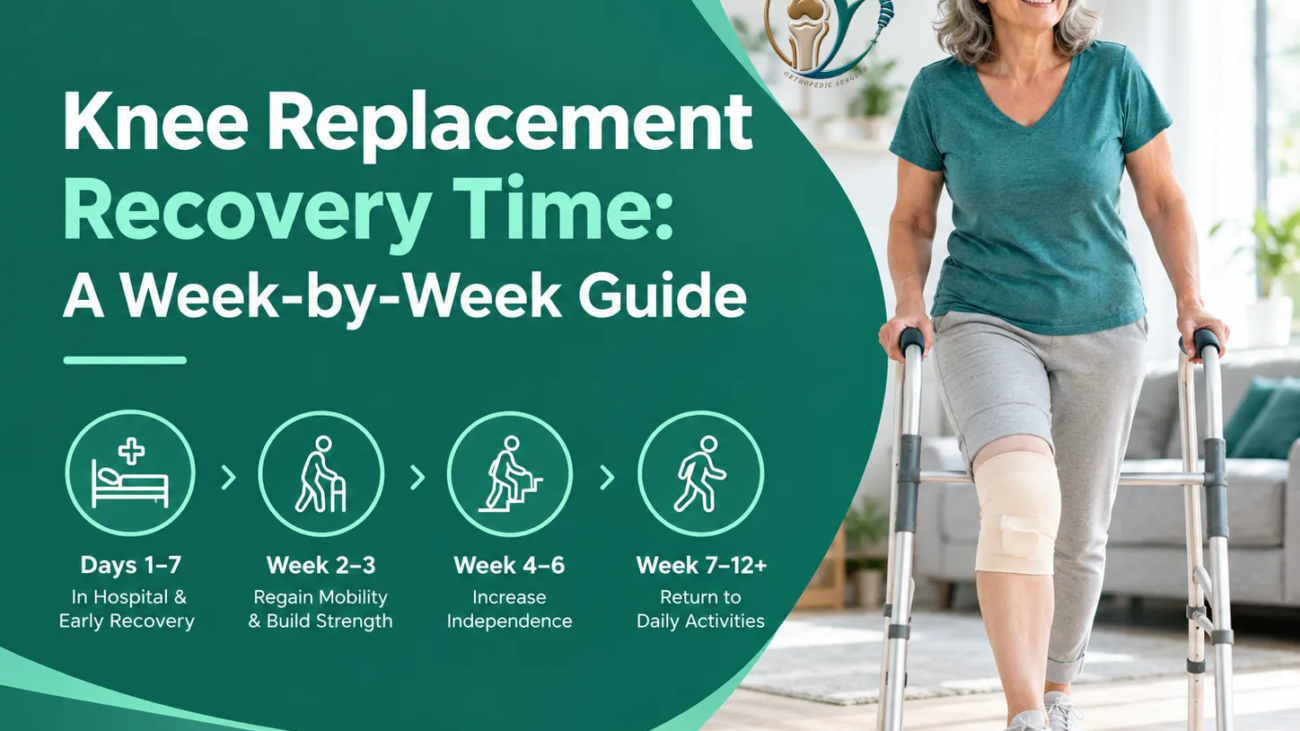
Following a structured schedule keeps you motivated and ensures each stage of soft-tissue healing proceeds smoothly. Breaking down your knee replacement recovery week by week provides a predictable pathway from surgical discharge to sports activities.
Weeks 1 to 2: Early Post-Operative Management and Safe Mobilization
The opening fortnight focuses on acute surgical site healing, systematic swelling management, and early quadriceps re-education. Many patients want to know how long to walk after knee replacement before their procedure. In modern orthopaedic settings, patients begin supporting standing and gentle stepping within hours after surgery.
During these initial days, walking aids such as crutches or a light walker provide vital mechanical balance. Physical therapy focuses on achieving at least 90 degrees of flexion and complete leg extension. Gentle ankle pumps and active heel slides reduce venous stasis while keeping the joint capsule mobile.
Rest, ice therapy, limb elevation, and prescribed medications keep early inflammation under control. By the end of the second week, surgical dressings are inspected, and tissue integrity is reviewed. Majority of the individuals move comfortably around their domestic living spaces using minimal walking assistance.
Weeks 3 to 4: Functional Mobility and Restoring Range of Motion
Entering the third and fourth weeks, your knee replacement recovery week by week journey shifts toward strength building. Soft-tissue inflammation subsides substantially, allowing your range of movement to expand beyond 100 degrees of natural flexion.
Rehabilitation exercises advance to mini-squats, stationary bicycle pedalling with light resistance, and supervized step-ups. Patients frequently transition away from walking aids indoors, using a single cane only when navigating unfamiliar outdoor settings.
Pain levels decrease noticeably during this window, shifting from sharp operative discomfort to a manageable muscular ache. Consistent physical therapy remains vital during total knee replacement recovery to prevent scar tissue adhesions from restricting joint flexibility.
Weeks 5 to 6: Independent Walking and Community Reintegration
By the sixth week, functional independence increases significantly as gait mechanics normalize. Patients rarely require walking aids during short trips and can navigate standard stairs using alternate leg movements. Inquiring about how long to walk after knee replacement becomes irrelevant by this phase, as unassisted community walks are standard.
Light household duties and social visits across Dubai generally become more manageable. Swelling may still fluctuate after long days of standing, making periodic icing and elevation beneficial. Driving a vehicle is often re-evaluated and cleared by your orthopaedic specialist once emergency braking reflexes return.
This stage frequently marks the initial return to work after knee replacement for desk-based professionals. Remote work or modified office duties can resume smoothly, provided you take short standing breaks to prevent stiffness.
Weeks 7 to 12: Advanced Strength and Low-Impact Sports
Between the seventh and twelfth weeks, muscular stamina and balance improve dramatically through advanced functional training. Therapy routines integrate lateral band walks, single-leg balancing exercises, and low-impact cardiovascular conditioning. Patients comfortably achieve full extension and over 115 degrees of flexion.
Recreational pursuits like swimming, gentle outdoor cycling, and brisk walking are safely reintroduced. Joint stiffness gradually improves, particularly morning tightness that previously felt persistent. Total knee replacement recovery milestones during this phase reflect restored confidence in the joint.
Patients in active industries often achieve their complete return to work after knee replacement during this period. Physical stamina matches regular workplace demands, allowing individuals to navigate full operational schedules without physical compromise.
Clinical Milestones Across Total Knee Replacement Recovery
Achieving favorable functional outcomes require systematic progression across several distinct physical phases. The table below outlines standard benchmarks throughout your total knee replacement recovery.
| Healing Phase | Functional Milestones | Rehabilitation Focus | Daily Independence Level |
| Weeks 1–2 | Early weight-bearing; 90° flexion | Cryotherapy, quad sets, ankle pumps | Supported walking; assistance needed |
| Weeks 3–4 | 100° flexion; independent indoor steps | Stationary cycling, active balance drills | Independent indoor mobility |
| Weeks 5–6 | Full extension; 110° flexion | Stair climbing, light driving clearance | Community errands; desk work |
| Weeks 7–12 | Over 115° flexion; smooth gait | Resistance training, low-impact cardio | Full domestic and travel autonomy |
| Months 3–6 | Advanced endurance; joint stability | Dynamic sport drills, functional power | Active lifestyle and sports participation |
Progressing steadily through total knee replacement recovery depends on clear communication with your medical team. Routine check-ups confirm correct mechanical alignment and better implant function.
Determining How Long to Walk After Knee Replacement
Patients regularly ask their orthopaedic team how long to walk after knee replacement without relying on support. Early assisted steps begin on day one to encourage blood flow and stimulate neural pathways. Independent unassisted walking, however, develops progressively over four to six weeks as muscle strength returns.
Rushing this timeline without adequate quadriceps power can lead to compensatory limping and back discomfort. Using a cane until your leg feels completely steady protects the joint components during early bone integration.
Tracking how long to walk after knee replacement without gait abnormalities is a major priority in physical therapy. Normal gait patterns prevent unnatural stress on your opposite limb, ensuring symmetrical biomechanics.
Managing Your Return to Work After Knee Replacement
Planning your return to work after knee replacement requires evaluating your exact daily physical occupational duties:
- Sedentary office roles: Desk-based professionals can typically resume light office work within four to six weeks. Ergonomic seating and periodic walking breaks help avoid postural stiffness during extended meetings.
- Moderate activity jobs: Roles involving standing, light lifting, or frequent site inspections usually require eight to ten weeks of recovery before safely resuming full workloads.
- High-demand physical labour: Heavy industrial employment or rigorous manual tasks may require a twelve-week transition to ensure the operative limb can tolerate continuous physical loads.
Discussing your job responsibilities with Dr. Muhieddine Hamie allows for a sensible transition plan. A phased schedule protects your healing joint while keeping your professional commitments on track.
Understanding your long-term prognosis also involves evaluating knee replacement lifespan and implant durability. Modern materials are engineered to provide durable, long-term performance when managed appropriately.
Advanced Surgical Technology and Recovery Optimization
Surgical approaches have evolved considerably beyond standard manual techniques. Advanced robotic-assisted systems allow surgeons to evaluate soft-tissue tension dynamically throughout the full arc of joint motion. This high level of operative precision helps optimize overall knee replacement recovery time.
Minimizing soft-tissue trauma translates to less post-operative swelling, manageable pain levels, and accelerated discharge timelines. Patients contemplating when to get a knee replacement should explore modern robotic resurfacing early. Addressing joint damage before extreme deformity develops ensures smoother soft-tissue balancing.
Opting for specialized Knee Replacement Surgery in Dubai gives patients direct access to internationally trained orthopaedic specialists. Dr. Muhieddine Hamie utilizes tissue-sparing protocols that support efficient functional recovery and long-term joint health.
Reclaim Your Active Independence Today
Living with debilitating joint wear severely impacts your professional vitality, personal independence, and daily well-being. Knowing what to expect regarding your knee replacement recovery time provides the clarity needed to proceed with surgical joint restoration.
Dr. Muhieddine Hamie delivers advanced clinical evaluations, digital surgical planning, and structured post-operative protocols. Our clinic in Dubai Healthcare City Phase 2 helps you transition smoothly from chronic discomfort to active, unrestricted living.
Schedule Your Comprehensive Joint Consultation
Take the decisive step toward long-term mobility and pain relief. Connect with the specialized team at Dr. Muhieddine Hamie Clinic to evaluate your knee health and begin your personalized treatment pathway. Book your consultation today through our online booking system or call our clinic directly.
Conclusion
Navigating your total knee replacement recovery requires patience, consistent rehabilitation, and experienced medical guidance. Early surgical intervention combined with robotic precision substantially shortens normal recovery periods while protecting joint stability.
By tracking your progress through each rehabilitation phase, you can steadily rebuild muscle strength, joint flexibility, and everyday endurance. Dedicated physical therapy transforms early clinical milestones into lifelong joint durability.
Restoring painless mobility allows you to return to professional commitments and enjoy Dubai’s active lifestyle. Partnering with a dedicated orthopaedic specialist ensures your surgical journey leads to lasting physical comfort and renewed vitality.
Frequently Asked Questions
1.What is the average knee replacement recovery time for active adults?
Majority of the adults resume everyday light routines within 6 weeks, while unassisted community walking develops between 4 to 8 weeks. Maximal muscular strength and full joint conditioning continue to improve over 6 to 12 months.
2.How soon will I walk after undergoing knee replacement surgery?
Patients typically take their first assisted steps with a physiotherapist on the day of surgery or the following morning. Assisted walking continues for usually 2 to 4 weeks before transitioning to independent, unassisted walking.
3.What is the typical timeline for returning to work after joint surgery?
Desk-based professionals generally return to office environments within 4 to 6 weeks. Occupations requiring prolonged standing, walking, or physical exertion usually require 8 to 12 weeks of structured rehabilitation before resuming work.
4.How does robotic assistance improve total knee replacement recovery?
Robotic assistance provides sub-millimeter surgical accuracy, ensuring implant positioning and balanced soft-tissue tension. This minimally invasive precision reduces intraoperative tissue trauma, minimizing post-operative swelling and helping support postoperative recovery.
5.When can I resume driving safely during my recovery period?
Patients can usually resume driving around approximately 4 to 6 weeks post-surgery, provided they are no longer taking narcotic pain medications and have regained sufficient muscle strength for emergency braking.
6.How long does joint swelling persist after knee replacement surgery?
Mild to moderate swelling is completely normal for 3 to 6 months post-surgery. Consistently elevating the limb, performing prescribed gentle exercises, and applying cryotherapy help control fluid buildup throughout your daily rehabilitation.