Navigating joint resurfacing requires a detailed understanding of how prosthetic components anchor to your natural skeleton. Evaluating cemented vs cementless knee replacement allows prospective surgical candidates to make informed, evidence-based decisions regarding long-term joint stability.
Many active residents across Dubai wonder whether contemporary press-fit implants outperform traditional fixation techniques. When analysing cemented vs cementless knee replacement, orthopaedic specialists examine bone mineral density, age, and individual activity goals. Understanding the biological and mechanical nuances of cemented vs cementless knee replacement ensures you select an approach matched to your lifestyle.
Fixation technology directly influences component longevity and everyday functional performance. Discussing cemented vs cementless knee replacement options with an experienced specialist provides reassurance throughout your surgical journey. At Dr. Hamie Clinic, patient assessments prioritise bone preservation, sub-millimeter surgical precision, and lasting mobility restoration.
Defining the Fixation Principles of Cemented vs Cementless Knee Replacement
The primary objective of knee resurfacing is seating durable prosthetic components firmly against the host bone. Comparing cemented vs cementless knee replacement highlights two distinct bio-mechanical methods for achieving structural stability.
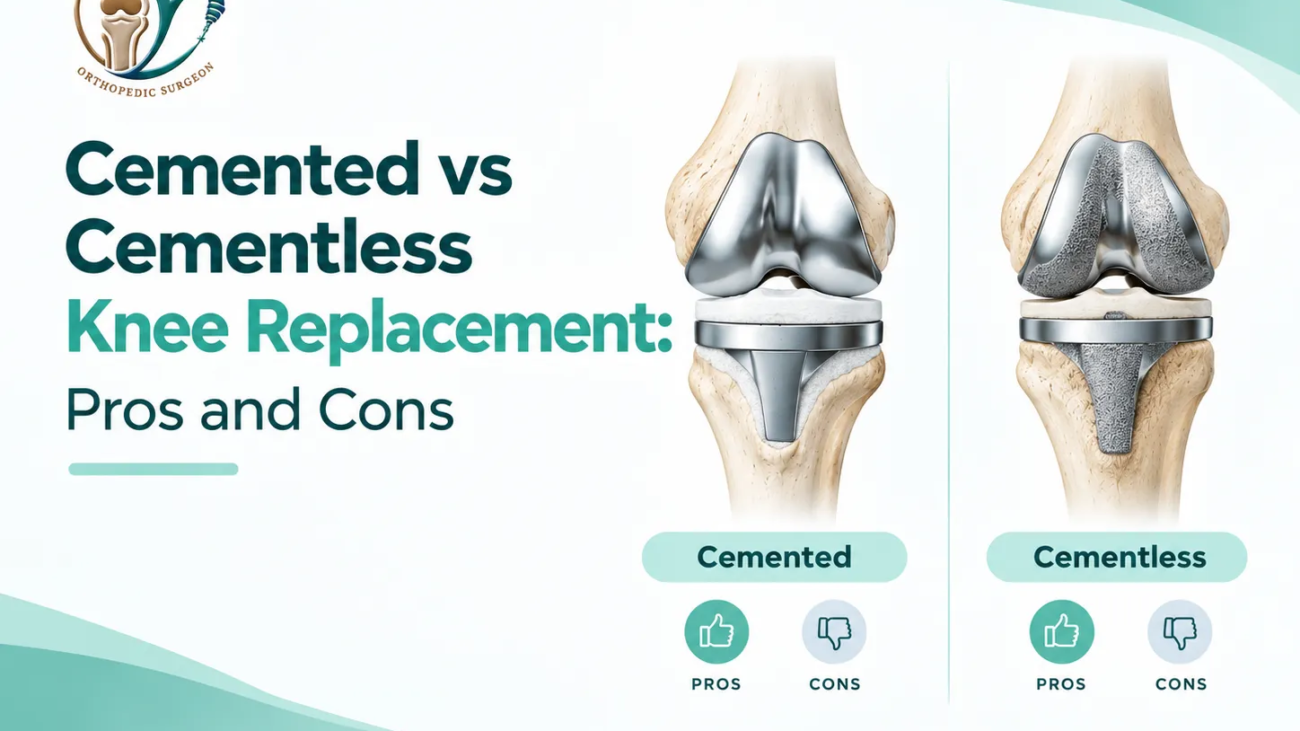
In a conventional approach, fast-curing polymethyl methacrylate acts as an anatomical grout between metal surfaces and cancellous bone. Conversely, studying cemented vs cementless knee replacement reveals that press-fit designs eliminate synthetic adhesives entirely. The back of the implant features a highly porous metallic surface that encourages living bone to interlock directly with the component.
Both approaches achieve rigid mechanical stability before the patient leaves the operating suite. Deciding between cemented vs cementless knee replacement comes down to the patient’s underlying bone biology rather than a simple choice between older and newer technology.
Detailed Overview of Cement Knee Replacement Mechanics
Known across the medical world as the historical gold standard, a cement knee replacement provides dependable, immediate mechanical interlock. Medical bone cement flows into tiny trabecular spaces within minutes, forming a rigid cushion that absorbs weight-bearing forces.
A notable advantage of a cement knee replacement is its reliability in bone of variable quality. Patients presenting with osteopenia, osteoporosis, or structural defects benefit from the filling properties of bone cement. The cured mantle provides uniform support, distributing contact stress evenly across the joint.
Surgeons can also incorporate specialized heat-stable antibiotics directly into the liquid polymer of a cement knee replacement. This local antimicrobial delivery helps protect surrounding tissues against bacterial colonization during initial healing. Decades of international registry data confirm that this fixation method delivers reliable survivorship across diverse patient groups.
However, bone cement remains a non-living, manufactured material. Over several decades of repetitive physical loading, microscopic cement fragmentation or debonding can occasionally occur, making regular clinical follow-up important.
Biological Integration in Modern Cementless Knee Replacement
Advancements in additive manufacturing have led to the increasing adoption of cementless knee replacement systems across modern orthopaedic centres. Often referred to clinically as press-fit arthroplasty, this approach relies on biological osseointegration.
The osseous surface of a cementless knee replacement component features highly porous titanium or tantalum structures resembling natural trabecular bone. During surgery, components are pressed tightly into meticulously prepared bone corridors. Over the subsequent six to twelve weeks, new osteoblasts migrate into the microscopic pores, locking the prosthesis in place biologically.
A successful cementless knee replacement achieves living, lifelong biological fixation. Because there is no synthetic cement layer to fatigue over time, the bone-implant interface remains adaptable. This biological stability makes press-fit components appealing for younger, active individuals in Dubai seeking high-demand mobility.
Nonetheless, biological integration requires healthy bone stock capable of cellular regeneration. In compromised or brittle bone, an uncemented knee replacement carries higher risks of early micro-motion, which can impede bone ingrowth and cause post-operative aching.
Clinical Comparison of Fixation Methods
Choosing the optimal surgical pathway requires weighing mechanical benefits against physiological suitability. The comparative framework below outlines primary differences across both fixation categories.
| Clinical Parameter | Cemented Fixation Profile | Cementless (Press-Fit) Profile |
| Fixation Mechanism | Polymethyl methacrylate bone grout interlock | Biological osseointegration into porous metal |
| Initial Stability | Immediate, rigid structural hold upon curing | High friction press-fit; progressive ingrowth |
| Operating Room Time | Slightly longer (requires cement curing window) | Modestly shorter (no cement mixing or curing) |
| Optimal Bone Quality | Adaptable to all bone grades, including osteoporosis | Requires robust cortical density and bone healing |
| Local Antibiotic Option | Antibiotics can be blended into liquid cement | No antibiotic delivery within the metal interface |
| Long-Term Interface | Durable synthetic interface with rare late fatigue | Living biological bond with ongoing bone remodelling |
Analysing these distinctions clarifies how your specific bone density guides surgical planning. Matching the fixation strategy to individual anatomy ensures a secure, predictable outcome.
Evaluating the Pros and Cons of Both Fixation Methods
Understanding the clinical trade-offs of both techniques helps patients establish realistic functional expectations. Orthopaedic surgeons evaluate specific advantages and limitations when recommending an approach:
- Immediate structural load: A cemented implant achieves maximum strength within fifteen minutes, making it suitable for patients needing predictable immediate weight-bearing.
- Biological bone preservation: An uncemented knee replacement preserves native bone stock by avoiding cement pressurization, which simplifies future modular revisions if needed.
- Operating efficiency: Press-fit components shorten overall surgical duration slightly by eliminating cement preparation, pressurized injection, and curing wait times.
- Sensitivity considerations: Skipping synthetic polymers eliminates the rare possibility of hypersensitivity or systemic cardiopulmonary reactions associated with monomer pressurization.
Weighing these points ensures that the chosen approach matches your physical conditioning. Balancing pros and cons thoroughly provides reassurance throughout the surgical journey.
Clinical Candidacy Across Cemented vs Cementless Knee Replacement
Determining candidacy for cemented vs cementless knee replacement involves pre-operative diagnostic imaging and intra-operative tactile assessment. High-resolution computed tomography scans and dual-energy X-ray absorptiometry evaluate bone mineral density and cortical thickness.
Surgeons frequently recommend a cementless knee replacement for active patients under sixty-five years of age with strong bone density. In these individuals, active cellular remodeling supports rapid, dense bone ingrowth into porous metal surfaces.
Conversely, older adults—particularly post-menopausal women with reduced bone density—frequently experience superior outcomes with a cemented procedure. In softer bone, cement distributes mechanical loads broadly, avoiding localized micro-fractures.
The surgeon’s tactile assessment during surgery remains the final deciding factor in cemented vs cementless knee replacement selection. If the prepared bone feels soft during preparation, switching to cement ensures reliable mechanical stability.
Hybrid Arthroplasty as an Intermediate Solution
In certain complex cases, orthopaedic surgeons utilize a hybrid fixation technique to leverage the advantages of both approaches. A hybrid procedure typically features an uncemented knee replacement femoral shield paired with a cemented tibial tray.
The distal femur possesses an anatomical shape and dense cancellous architecture that naturally supports reliable press-fit bone ingrowth. Conversely, the proximal tibia absorbs significant rotational and vertical shear forces, where cement provides dependable baseline stability.
Utilizing hybrid fixation provides a balanced solution when bone quality varies between the femur and tibia. This flexible approach allows the surgical team to tailor fixation to the specific mechanical demands of each joint compartment.
Reviewing these surgical variations clarifies why cemented vs cementless knee replacement is an individualized decision. Personalizing the fixation strategy ensures that your artificial joint remains stable and comfortable.
Rehabilitation Benchmarks and Functional Durability
Post-operative rehabilitation follows a structured path regardless of the chosen fixation method. Understanding your anticipated knee replacement recovery time helps set practical milestones for walking independence, driving, and returning to professional commitments. Modern tissue-sparing approaches allow both cemented and press-fit patients to begin supported walking on the day of surgery.
Exploring broader types of knee replacement helps candidates understand how partial or total joint resurfacing influences recovery schedules. Comparing total vs partial knee replacement shows that bone-preserving partial procedures frequently integrate well with press-fit technologies when bone stock is strong.
Understanding clinical registry data regarding knee replacement longevity provides confidence for the future. Well-aligned implants—whether secured with cement or living bone ingrowth—regularly achieve survivorship rates beyond twenty to twenty-five years.
Patients seeking specialized knee surgery in Dubai receive individualized care from fellowship-trained orthopaedic specialists. Dr. Muhieddine Hamie utilizes advanced digital templating and tissue-sparing techniques to deliver predictable joint restoration.
Advanced Surgical Technology at Dr. Hamie Clinic
Achieving dependable implant fixation relies on surgical precision. At Dr. Hamie Clinic in Dubai Healthcare City Phase 2, Dr. Muhieddine Hamie incorporates cutting-edge robotic navigation and dynamic digital imaging into operative planning.
Robotic guidance ensures that bone resections match component dimensions within sub-millimeter tolerances. In press-fit procedures, this level of precision is essential to create the tight bone-to-implant contact required for cellular ingrowth. In cemented procedures, accurate bone cuts establish a uniform cement mantle that protects against late mechanical loosening.
Dr. Hamie conducts thorough clinical consultations to evaluate your bone quality and lifestyle goals. By tailoring every surgical detail to the patient’s individual anatomy, the clinic delivers joint restoration designed to support active, pain-free living across the UAE.
Reclaim Your Active Independence and Joint Comfort Today
Living with debilitating joint osteoarthritis should not restrict your personal vitality, professional career, or active lifestyle across Dubai. Evaluating cemented vs cementless knee replacement provides the knowledge needed to pursue joint restoration with total confidence.
Dr. Muhieddine Hamie provides comprehensive diagnostic evaluations, bone quality assessments, and advanced robotic joint resurfacing at Dr. Hamie Clinic. Take decisive action to eliminate chronic knee pain, safeguard your bone health, and enjoy decades of comfortable mobility.
Schedule Your Comprehensive Orthopaedic Consultation
Connect directly with the clinical team at Dr. Hamie Clinic in Dubai to evaluate your joint health and discover whether cemented or press-fit fixation suits your anatomy best.
Conclusion
Navigating modern joint reconstruction requires specialist diagnostic guidance, accurate bone density assessment, and tailored surgical execution. Both cemented and press-fit fixation strategies deliver excellent outcomes when matched to appropriate patient indications.
Understanding the clinical nuances of cemented vs cementless knee replacement ensures that your surgical plan accounts for subtle anatomical variations, age, and activity goals. Meticulous surgical technique ensures balanced weight-bearing forces, protecting components from premature loosening.
Partnering with an experienced orthopaedic specialist ensures your surgical journey delivers lasting comfort and mobility. Restoring smooth, natural joint function empowers you to enjoy Dubai’s vibrant professional, social, and recreational lifestyle without physical boundaries.
Frequently Asked Questions
1.What is the main difference between cemented vs cementless knee replacement?
Cemented replacement secures implants using rapid-curing polymethyl methacrylate bone grout. Cementless fixation utilizes a porous metal surface that allows natural bone to grow directly into the implant over several weeks.
2.Which patients are suitable candidates for cementless knee replacement?
Younger, active patients under 65 with robust bone mineral density, healthy cortical bone, and good regenerative capacity are typically the best candidates for press-fit biological fixation.
3.Why is a cement knee replacement still considered the gold standard?
Cemented fixation has decades of proven clinical registry data demonstrating over 90% survival past 15 to 20 years. It provides dependable immediate fixation across all bone types, including osteoporotic bone.
4.Does recovery take longer with an uncemented knee replacement?
Initial recovery and walking milestones are comparable, with patients walking on day one. However, cementless implants require 6 to 12 weeks for biological bone ingrowth to mature fully into the porous surface.
5.Can bone cement cause allergic reactions or complications?
True bone cement allergies are rare. Modern surgical techniques utilize vacuum-mixing and careful pressurization to minimize systemic reactions and establish a clean, durable cement mantle.
6.How does a surgeon decide between cemented and press-fit fixation during surgery?
While preoperative scans evaluate bone density, the surgeon assesses bone firmness directly during operative preparation. If the bone feels soft, cemented fixation is selected to ensure reliable stability.