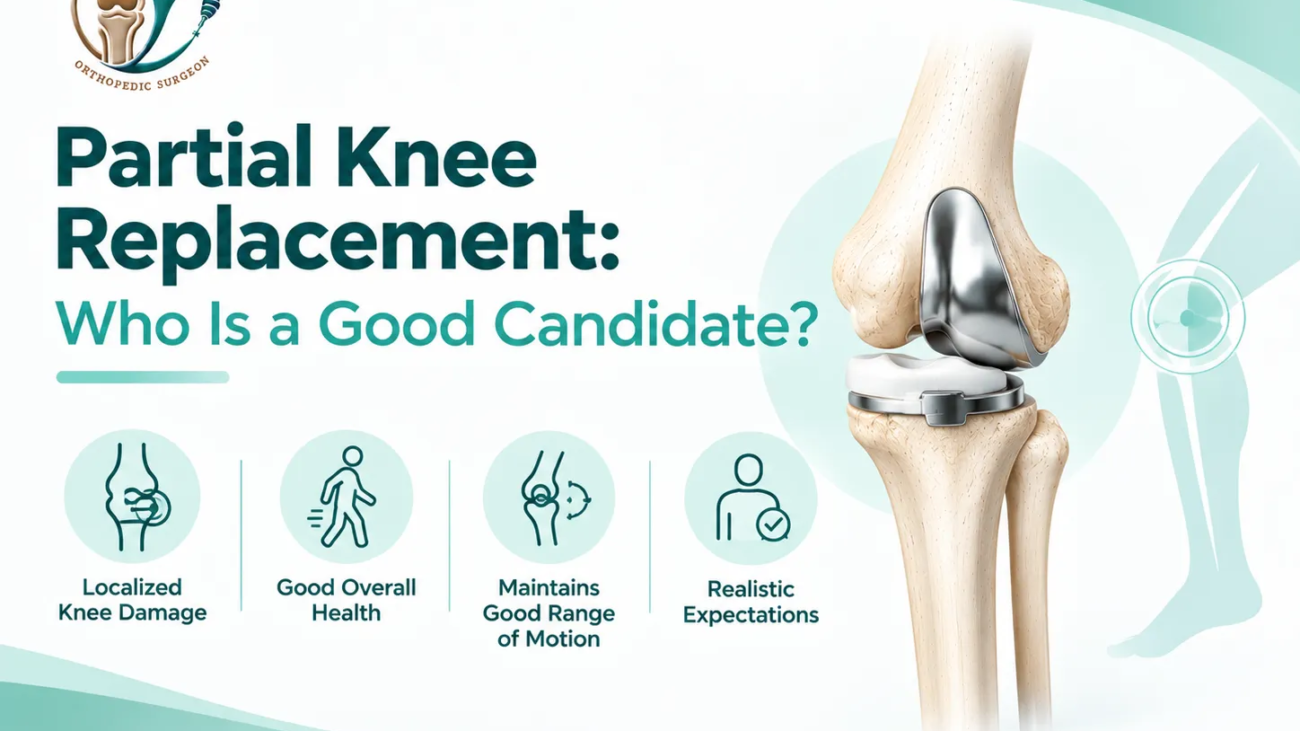
Chronic knee pain can significantly alter everyday living, work productivity, and recreational pursuits across Dubai. When conservative therapies fail to provide lasting relief, evaluating whether you qualify as a partial knee replacement candidate becomes an essential orthopaedic milestone.
Many active residents assume that surgical joint intervention always requires replacing the entire knee joint. However, advancing orthopaedic techniques allow surgeons to target isolated cartilage wear precisely. Establishing yourself as an optimal partial knee replacement candidate ensures that healthy bone, intact cartilage, and native ligaments remain safely preserved.
Determining who benefits most from partial joint resurfacing requires in-depth clinical analysis and precise diagnostic imaging. Consulting an experienced specialist helps verify if you meet the profile of a partial knee replacement candidate. At Dr. Muhieddine Hamie Clinic, patient assessments prioritise joint preservation, tissue-sparing accuracy, and long-term functional mobility.
Defining the Profile of a Partial Knee Replacement Candidate
A suitable partial knee replacement candidate typically experiences joint degeneration confined strictly to one anatomical zone of the knee. The human knee comprises three functional compartments: the inner medial side, the outer lateral side, and the anterior patellofemoral space beneath the kneecap.
When arthritis affects only one compartment, resurfacing the entire joint is often unnecessary. In these targeted cases, qualifying as a partial knee replacement candidate allows patients to experience smaller operative incisions, lower blood loss, and a far more biological joint sensation. The native cruciate ligaments remain untouched, ensuring that normal knee reflexes and proprioception stay intact.
A comprehensive clinical assessment confirms whether a patient represents a safe partial knee replacement candidate. Dr. Muhieddine Hamie evaluates dynamic joint stability, localized tenderness, and physical range of motion to ensure targeted resurfacing delivers lasting durability.
Anatomy and Mechanics of Medial Compartment Arthritis
The vast majority of unicompartmental surgical procedures address localized wear on the inside aspect of the knee joint. Developing isolated medial compartment arthritis is exceptionally common due to the natural weight-bearing alignment of the lower extremity. During regular walking strides, the medial compartment absorbs approximately 60% to 70% of total ground reaction forces.
As mechanical stress persists over years, the protective articular cartilage within the medial joint space gradually thins. Patients coping with progressive medial compartment arthritis notice aching localised exclusively along the inner joint line. Swelling, stiffness after periods of sitting, and discomfort when descending stairs frequently indicate focal wear.
Treating isolated medial compartment arthritis with unicompartmental resurfacing shields the remaining compartments from premature surgical alterations. When lateral and patellofemoral cartilage remains healthy, targeting only the diseased medial tissue optimizes post-operative biomechanics. Identifying focal wear early confirms whether you are an appropriate partial knee replacement candidate.
Essential Diagnostic Unicompartmental Knee Replacement Criteria
Orthopaedic surgeons follow rigorous, evidence-based guidelines to verify candidate suitability before recommending partial resurfacing. Reviewing standard unicompartmental knee replacement criteria ensures that the intervention remains successful over decades:
- Compartmental isolation: Articular cartilage wear must remain strictly confined to a single compartment, verified by weight-bearing radiographs and MRI evaluation.
- Intact ligamentous stability: The anterior cruciate ligament and posterior cruciate ligament must be fully functional to support the biomechanics of a unicompartmental implant.
- Correctable axial alignment: Varus or valgus leg deformities must remain passively correctable and should not exceed mild structural angulation thresholds.
- Preserved range of motion: Patients should demonstrate at least 90 degrees of knee flexion with minimal fixed flexion contracture prior to surgery.
- Absence of inflammatory disease: Candidates must have degenerative osteoarthritis rather than systemic inflammatory arthritis such as rheumatoid or psoriatic disease.
Careful adherence to these unicompartmental knee replacement criteria minimizes early revision risks. Patients who satisfy these clinical parameters achieve superior functional satisfaction and rapid mobility restoration.
Clinical Comparison of Patient Candidacy Profiles
Determining whether you match a full or partial resurfacing profile requires analyzing structural imaging alongside clinical examinations. The comparative matrix below outlines key physiological markers across both patient categories.
| Diagnostic Parameter | Ideal Partial Knee Replacement Candidate | Total Knee Replacement Candidate |
| Arthritic Distribution | Isolated single-compartment degeneration | Generalized multi-compartment arthritis |
| Ligament Integrity | Fully competent ACL and collateral ligaments | Attenuated, absent, or deficient ACL |
| Pain Localization | Exclusively localized to the medial or lateral side | Diffuse, generalized pain encircling entire joint |
| Joint Contracture | Flexion contracture less than 5 to 10 degrees | Significant fixed flexion deformity (>15 degrees) |
| Inflammatory Profile | Non-inflammatory primary or secondary osteoarthritis | Systemic inflammatory arthritis (e.g., rheumatoid) |
| Patient Proprioception | Highly preserved; retains native joint feel | Stable, predictable, artificial bearing mechanics |
Evaluating these clinical metrics clarifies why a patient qualifies as a partial knee replacement candidate. Aligning surgical technique with anatomical reality guarantees the highest standard of musculoskeletal care.
Evaluating Am I a Candidate for Partial Knee Replacement
Patients experiencing chronic, isolated knee discomfort frequently ask am I a candidate for partial knee replacement during specialist consultations. Answering this question begins with a thorough diagnostic assessment, including standing long-leg alignment films and magnetic resonance imaging.
Imaging scans reveal whether cartilage depletion is truly isolated or whether micro-degeneration has begun in adjacent compartments. During your physical examination, the surgeon confirms that joint line pain matches radiographic findings. If you ask am I a candidate for partial knee replacement, testing also evaluates whether passive pressure can correct mild leg bowing back to neutral alignment.
Your daily activity goals and expectations also influence whether am I a candidate for partial knee replacement. Individuals who enjoy active walking, golf, swimming, or cycling thrive with partial resurfacing because the knee preserves natural kinematics. Dr. Muhieddine Hamie discusses functional goals openly to verify that unicompartmental resurfacing matches your personal lifestyle demands.
Contraindications for Partial Knee Replacement Surgery
While unicompartmental joint resurfacing provides clear functional benefits, it is not clinically indicated for every patient. Understanding clinical contraindications protects patients from undergoing an intervention that may experience premature mechanical wear:
- Generalized inflammatory joint disease: Conditions like rheumatoid arthritis affect the entire synovial lining, inevitably causing disease progression in preserved compartments.
- Severe fixed angular deformities: Severe, rigid bowing or knock-kneed alignment cannot be corrected with a unicompartmental prosthesis alone.
- Cruciate ligament incompetence: A deficient anterior cruciate ligament causes excessive anteroposterior shear forces, leading to early implant loosening.
- Bicompartmental cartilage loss: Active, symptomatic arthritis involving both the medial and lateral spaces requires complete joint resurfacing.
A detailed clinical evaluation verifies that each prospective partial knee replacement candidate does not exhibit these contraindications. Selecting candidates meticulously guarantees that the prosthesis remains durable, secure, and fully functional for years to come.
Rehabilitation Trajectories and Functional Milestones
One of the greatest advantages for any partial knee replacement candidate is an accelerated rehabilitation pathway. Because surgical trauma is confined to a single compartment, surrounding musculature sustains minimal disruption during the procedure.
Patients regularly inquire about their anticipated partial knee replacement recovery time when planning professional and social leave. Most individuals stand and take assisted steps within hours of surgery, achieving unassisted indoor walking within two to three weeks.
Structured physical therapy focuses on rebuilding quadriceps activation, expanding flexion beyond 120 degrees, and restoring symmetrical balance. Understanding how recovery timelines compare between total vs partial knee replacement highlights the rapid return to daily living offered by targeted unicompartmental care.
Dedicated rehabilitation transforms clinical success into lifelong joint health. Patients who satisfy unicompartmental criteria resume light sports, recreational walking, and community activities far faster than traditional surgical timelines allowed.
Advanced Surgical Technology at Dr. Muhieddine Hamie Clinic
Modern joint reconstruction has evolved dramatically through robotic navigation and patient-specific digital instrumentation. Sub-millimeter surgical accuracy ensures that unicompartmental implants are positioned to match your unique joint kinematics precisely.
Dr. Muhieddine Hamie utilizes advanced tissue-sparing techniques at his Dubai Healthcare City practice. Digital joint mapping verifies that implant components balance soft-tissue tension perfectly throughout the complete arc of motion. This precision protects surrounding cartilage and maximizes prosthetic longevity.
Residents across the UAE seeking world-class Knee joint replacement surgery in Dubai receive individualized care plans tailored to their specific musculoskeletal needs. Identifying yourself as a suitable partial knee replacement candidate ensures that treatment restores comfortable, natural joint movement without unnecessary surgical intervention.
Under the expert guidance of Dr. Muhieddine Hamie, surgical planning pairs diagnostic precision with advanced operative technology. Patients regain joint stability, eliminate chronic localized pain, and return to their dynamic lifestyles with complete confidence.
Reclaim Your Active Independence and Joint Comfort
Chronic knee discomfort should not restrict your vitality, personal independence, or active routine across Dubai. Evaluating whether you qualify as a partial knee replacement candidate provides the clinical clarity needed to pursue targeted joint restoration.
Dr. Muhieddine Hamie offers advanced diagnostic evaluations, conservative management pathways, and cutting-edge unicompartmental resurfacing. Take proactive steps to eliminate localized joint pain, preserve your healthy joint structures, and reclaim your dynamic mobility.
Schedule Your Comprehensive Orthopaedic Consultation
Connect directly with the clinical team at Dr. Muhieddine Hamie Clinic in Dubai to evaluate your knee health and determine if you meet the criteria for partial joint resurfacing.
Conclusion
Navigating unicompartmental joint reconstruction requires an expert clinical assessment, precise imaging, and an evidence-based approach to candidate selection. Resurfacing only the damaged compartment allows you to eliminate debilitating pain while retaining the biological feel of your native joint.
Adhering strictly to established clinical criteria ensures that your surgical outcome remains stable, comfortable, and durable. Modern robotic assistance and tissue-sparing methods allow patients to rebuild muscle strength and resume daily living with minimal downtime.
Partnering with a specialized orthopaedic surgeon provides peace of mind throughout every phase of joint restoration. Restoring fluid, pain-free joint function empowers you to enjoy Dubai’s vibrant professional, social, and recreational lifestyle without physical limitations.
Frequently Asked Questions
1.What makes an individual an ideal partial knee replacement candidate?
An ideal candidate has osteoarthritis confined strictly to one knee compartment, intact cruciate ligaments, good range of motion, and mild, correctable joint alignment without systemic inflammatory conditions.
2.How do I know if I am a candidate for partial knee replacement?
You may qualify if your joint pain is localized exclusively to the inside or outside of the knee, your ligaments are stable, and standing X-rays confirm cartilage remains healthy in the other two compartments.
3.What are the primary unicompartmental knee replacement criteria used by surgeons?
Key criteria include single-compartment arthritis, intact anterior and posterior cruciate ligaments, at least 90 degrees of pre-operative flexion, correctable alignment, and absence of inflammatory joint disease.
4.Can medial compartment arthritis be treated with a partial replacement?
Yes, medial compartment wear is the most common reason for partial knee replacement. Resurfacing only the worn inner compartment relieves pain while preserving healthy lateral and patellofemoral cartilage.
5.How does recovery differ for a partial knee replacement candidate?
Because the incision is smaller and healthy tissue is spared, recovery is typically faster. Most patients resume unassisted walking within 2 to 3 weeks and achieve full functional recovery in 6 to 10 weeks.
6.Can a partial knee replacement be converted to a total knee replacement later?
Yes, if arthritis eventually develops in the preserved compartments years or decades later, the unicompartmental implant can be cleanly revised to a standard total knee replacement.