Chronic joint wear can transform simple daily movements into severe physical challenges. When non-surgical therapies no longer relieve chronic joint degradation, comparing total vs partial knee replacement becomes essential for restoring pain-free mobility.
Many active residents across Dubai believe that arthroplasty requires replacing the entire joint. However, modern surgical techniques offer compartment-specific options. Understanding the nuances of total vs partial knee replacement allows you to make informed decisions regarding joint preservation and functional restoration.
Every knee joint features three distinct functional compartments: medial, lateral, and patellofemoral. Analysing total vs partial knee replacement options helps determine whether resurfacing a single damaged compartment or the entire joint is appropriate. Specialist assessment with Dr. Muhieddine Hamie ensures your care matches your exact anatomical requirements.
Anatomy and Mechanics Behind Total vs Partial Knee Replacement
The human knee functions as a complex hinged structure divided into three individual anatomical zones. The medial compartment sits on the inner side, the lateral compartment occupies the outer side, and the patellofemoral compartment supports movement between the kneecap and thigh bone. Evaluating total vs partial knee replacement begins by identifying which zones suffer from articular cartilage erosion.
Cartilage breakdown does not always affect all three compartments simultaneously. In many individuals, cartilage depletion remains confined strictly to the inner medial compartment while adjacent cartilage remains healthy. In these situations, assessing total vs partial knee replacement helps decide if full joint reconstruction is necessary.
Choosing the proper procedure depends on your anatomical patterns of joint wear. Reviewing total vs partial knee replacement parameters ensures the selected intervention targets diseased tissue while safeguarding healthy bone and native ligaments.
Detailed Evaluation of Partial vs Total Knee Replacement
A comprehensive review of partial vs total knee replacement highlights how surgical approaches address specific degrees of arthritis. The key difference lies in the volume of bone, cartilage, and soft tissue altered during the procedure.
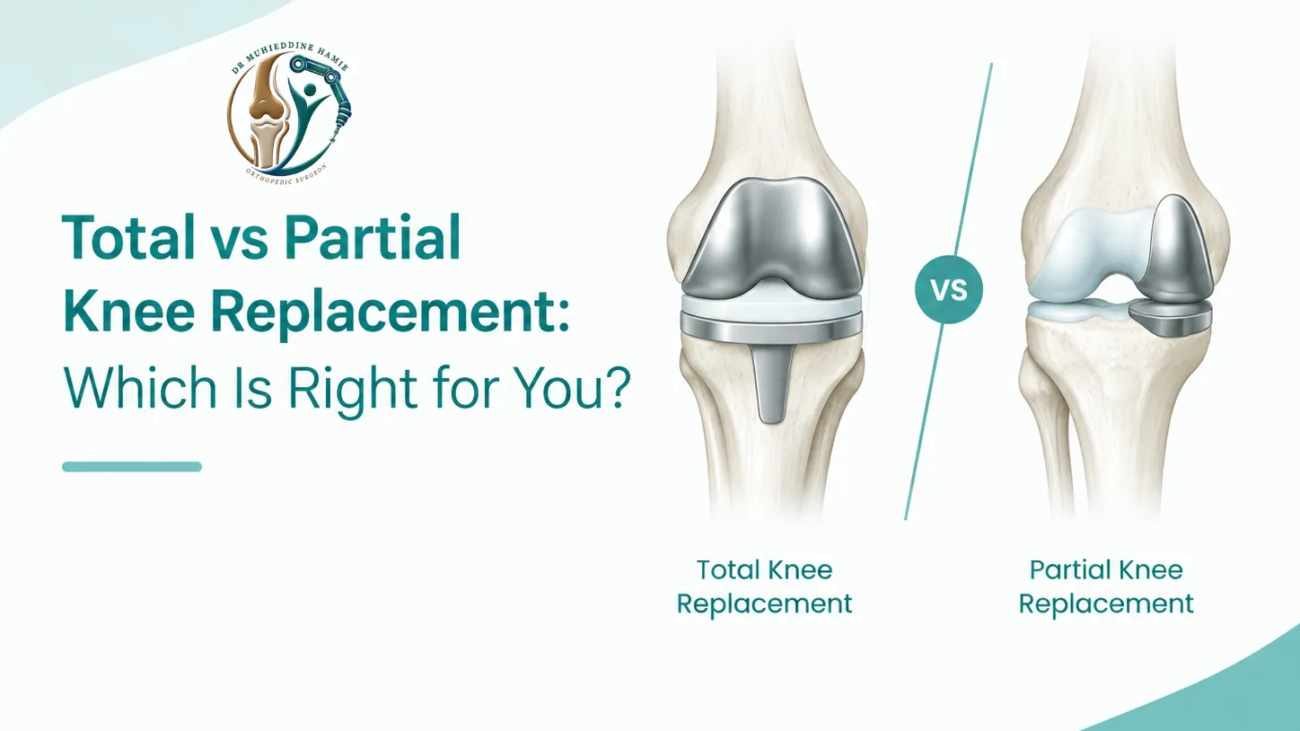
In a unicompartmental approach, the surgeon resurfaces only the singular damaged compartment using precision implants. The healthy native cartilage in the remaining compartments remains completely untouched. Crucially, the anterior cruciate ligament and posterior cruciate ligament are fully preserved, maintaining natural joint proprioception.
Conversely, looking at partial vs total knee replacement for generalized wear shows that total arthroplasty resurfaces all three compartments. The surgeon replaces the damaged femoral, tibial, and patellar surfaces with engineered medical implants. This comprehensive resurfacing resolves severe multi-compartment arthritis and corrects advanced angular leg deformities.
Practical Comparisons of Half Knee vs Full Knee Replacement
Patients frequently refer to this clinical choice as a half knee vs full knee replacement. While the terminology is casual, the practical differences regarding surgical impact, blood conservation, and rehabilitation pathways are clinically significant.
Undergoing a half knee vs full knee replacement involves a smaller skin incision and substantially less soft-tissue retraction. Because healthy bone stock remains intact, post-operative swelling and systemic inflammatory responses remain low. Patients routinely report that a partial resurfacing feels closer to their natural joint during walking and deep bending.
However, selecting a half knee vs full knee replacement requires meeting strict anatomical criteria. If arthritis eventually develops in the preserved compartments over time, subsequent surgical revision may be required. Full resurfacing addresses the entire joint environment, eliminating future arthritic risk in adjacent compartments.
Surgical Comparison of Unicompartmental vs Total Knee Replacement
Understanding the clinical definitions of unicompartmental vs total knee replacement assists candidates in evaluating surgical outcomes. The table below outlines fundamental surgical and biomechanical distinctions between both techniques.
| Clinical Parameter | Unicompartmental Knee Replacement | Total Knee Replacement |
| Arthritic Extent | Isolated to one compartment (medial or lateral) | Multi-compartment joint degeneration |
| Incision Size | Minimally invasive (typically 7 to 10 cm) | Standard arthroplasty (typically 15 to 20 cm) |
| Ligament Preservation | Retains both ACL and PCL intact | Cruciate ligaments resurfaced or rebalanced |
| Hospital Stay | Outpatient or 24-hour observation | Typically 1 to 3 days in hospital |
| Natural Joint Feel | High proprioception and natural biomechanics | Stable, predictable, highly durable joint |
| Subsequent Revision | Can be converted to full arthroplasty if wear spreads | Long-term revision involves modular implants |
Evaluating unicompartmental vs total knee replacement metrics confirms that neither procedure is universally superior for every patient. Instead, success relies on matching the appropriate surgical design to your specific cartilage condition and joint alignment.
Candidate Selection for Total vs Partial Knee Replacement
Identifying whether you are a suitable candidate for total vs partial knee replacement involves comprehensive radiographic and clinical diagnostics. Weight-bearing radiographs and magnetic resonance imaging evaluate cartilage thickness, osteophyte formation, and ligament integrity across all compartments.
Ideal candidates for partial resurfacing present with isolated joint pain, intact cruciate ligaments, and preserved joint flexibility. If severe stiffness, inflammatory rheumatoid conditions, or marked limb malalignment exist, a full joint replacement is typically recommended.
Your general physical condition, body mass index, and personal athletic goals also influence total vs partial knee replacement suitability:
- Single-compartment wear: Localised medial or lateral pain with well-preserved adjacent cartilage points toward partial joint reconstruction.
- Intact native stability: A fully competent anterior cruciate ligament is an essential requirement for partial resurfacing stability.
- Advanced generalised arthritis: Diffuse cartilage thinning across multiple zones warrants full joint reconstruction to avoid persistent symptoms.
- Fixed joint contractures: Patients with substantial angular deformities require total arthroplasty to realign the mechanical weight-bearing axis.
Long-Term Durability and Total vs Partial Knee Replacement
Prosthetic longevity represents a vital consideration when evaluating total vs partial knee replacement. Historically, full knee implants demonstrated longer survivorship compared to early unicompartmental implants. However, modern robotic navigation and bio-compatible materials have closed this historical performance gap.
Modern unicompartmental implants demonstrate excellent survivorship rates extending past fifteen to twenty years in well-selected candidates. If wear gradually emerges in untreated compartments decades later, converting the prosthesis to a full implant remains a straightforward clinical solution.
Understanding your implant’s anticipated knee replacement lifespan involves evaluating daily joint stress and post-operative lifestyle habits. Maintaining lower-impact physical activities protects the polyethylene bearing surfaces across both surgical types.
Recovery Trajectories for Total vs Partial Knee Replacement
Post-operative rehabilitation timelines differ noticeably between both surgical approaches. Because partial resurfacing involves smaller incisions and minimal muscle disruption, soft-tissue recovery progresses rapidly. Majority of the partial resurfacing patients mobilize comfortably within hours of leaving the operating theater.
Full joint arthroplasty requires a more gradual rehabilitation period to allow extensive soft-tissue balancing to settle. Understanding your anticipated knee replacement recovery time helps set realistic milestones for independent walking, driving, and returning to professional duties.
Physical therapy plays a decisive role across total vs partial knee replacement protocols. Guided rehabilitation rebuilds quadriceps strength, improves flexion angles, and prevents the formation of restrictive internal scar tissue.
Advanced Surgical Technology at Dr. Muhieddine Hamie Clinic
Precision engineering has transformed outcomes across total vs partial knee replacement procedures. Advanced robotic navigation systems and dynamic intraoperative sensors allow orthopaedic surgeons to align prosthetics within sub-millimeter tolerances.
Dr. Muhieddine Hamie combines international training with advanced digital imaging at his Dubai Healthcare City practice. Digital joint mapping verifies that implant positioning matches your personal kinematics, whether undergoing partial resurfacing or complete reconstruction.
Knowing when to get a knee replacement prevents irreversible mechanical stress from damaging surrounding soft-tissue envelopes. Proactive surgical intervention protects bone stock and ensures faster functional restoration.
Patients seeking specialized Knee Replacement Surgery in Dubai receive individualized care plans tailored to their daily activity requirements. Comprehensive diagnostics guarantee that your surgical recommendation aligns with evidence-based orthopaedic standards.
Transform Your Joint Mobility and Daily Vitality
Debilitating joint pain should not limit your lifestyle or restrict your movement across Dubai. A focused orthopaedic evaluation clarifies whether total vs partial knee replacement offers the ideal pathway to pain-free function.
Dr. Muhieddine Hamie provides advanced diagnostic imaging, tissue-preserving operative techniques, and structured rehabilitation protocols. Reclaim comfortable walking strides and dynamic athletic vitality through individualized joint care.
Schedule Your Comprehensive Orthopaedic Evaluation
Connect directly with the surgical team at Dr. Muhieddine Hamie Clinic in Dubai to explore whether partial or full joint resurfacing suits your condition. Book your private consultation today via our online appointment portal or contact our Al Jaddaf clinic directly.
Conclusion
Navigating total vs partial knee replacement requires expert surgical evaluation, proper joint imaging, and realistic recovery expectations. Choosing the appropriate procedure safeguards your native knee anatomy while eliminating severe arthritic pain.
Both partial resurfacing and complete arthroplasty provide durable outcomes when matched to appropriate patient indications. Advanced operative technologies ensure balanced joint mechanics, natural articulation, and swift community reintegration.
Partnering with an experienced orthopaedic surgeon empowers you to address progressive joint degeneration with complete confidence. Restoring pain-free joint function allows you to enjoy Dubai’s vibrant professional, social, and recreational lifestyle.
Frequently Asked Questions
1.What is the main difference in total vs partial knee replacement?
Total replacement resurfaces all three knee compartments using metal and polyethylene implants. Partial replacement targets only the single damaged compartment, preserving healthy native bone, cartilage, and both cruciate ligaments.
2.How does recovery differ in partial vs total knee replacement?
Partial knee recovery is typically faster with smaller incisions, less muscle disturbance, and shorter hospital stays. Total replacement recovery requires more structured rehabilitation to manage balanced soft-tissue adjustments.
3.Is a half knee vs full knee replacement more durable?
Full knee replacements traditionally have slightly higher twenty-year survivorship rates. However, modern robotic partial replacements provide excellent longevity exceeding fifteen to twenty years in properly selected candidates.
4.Who qualifies as a candidate for unicompartmental vs total knee replacement?
Candidates for unicompartmental surgery must have arthritis confined to one compartment, intact cruciate ligaments, and preserved joint flexibility. Generalized wear across multiple zones requires total knee replacement.
5.Can a partial knee replacement be converted to a full replacement later?
Yes, if arthritis eventually spreads to untreated compartments in subsequent decades, a partial knee implant can be revised cleanly into a standard total knee replacement.
6.Does a partial knee replacement feel more natural than a total knee?
Yes, preserving your native anterior and posterior cruciate ligaments during partial knee surgery maintains natural joint proprioception, resulting in a knee that feels more like your biological joint.